Why Humidity in the Poultry Shed Matters More Than Most Farmers Realise
Ask ten poultry farmers what they monitor most carefully in their sheds, and nine of them will say temperature. That's understandable — temperature is visible. You can feel it when you walk in. The birds tell you immediately when it's wrong.
Humidity tells a quieter story. It doesn't announce itself with huddled chicks or panting birds — not immediately, anyway. It works in the background, affecting litter condition, respiratory health, disease pressure, and feed conversion in ways that can take days or weeks to become obvious. By the time humidity problems show up as sick birds or poor growth, they've usually been building for longer than you'd like.
This is the part of environmental management that gets the least attention and causes more production losses than most farmers realise.
What Humidity Actually Is and Why It Affects Your Birds
Humidity is the amount of water vapour present in the air. In a poultry context, we measure it as relative humidity — the percentage of water vapour in the air relative to the maximum amount that air could hold at a given temperature.
The relationship between humidity and temperature is inseparable. Warm air holds more moisture than cold air. This is why a shed that feels perfectly comfortable at 20°C can become oppressively humid at 30°C with the same number of birds producing the same amount of moisture through respiration and excretion. As temperature rises, your humidity management challenge intensifies.
For poultry — whether commercial broilers, layers, or Sonali desi chickens — the generally recommended relative humidity range during the main production period is between 50% and 70%. Below that range, you have dry air problems. Above it, you have wet air problems. Both cause real harm, but in different ways.
What Happens When Humidity Is Too High
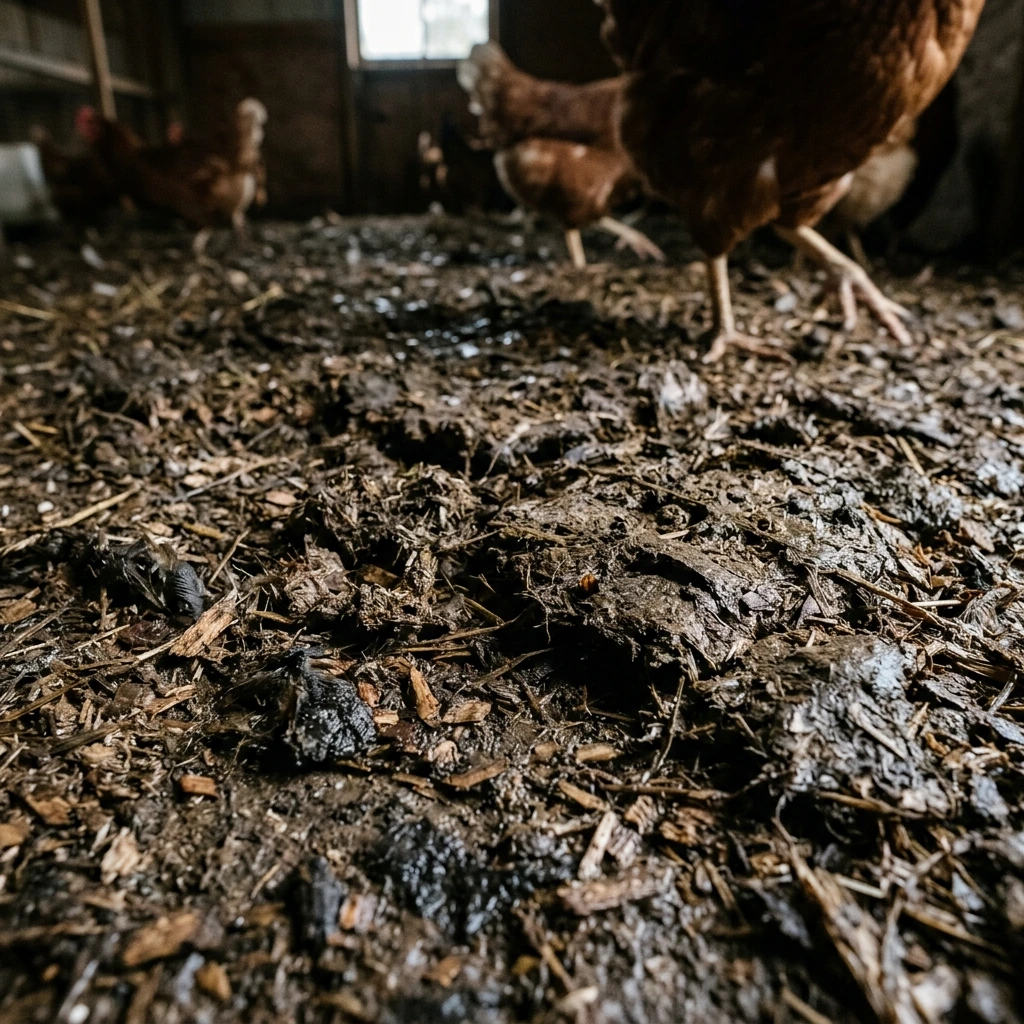
High humidity in a poultry shed is almost always a litter problem waiting to happen. When the air is saturated with moisture, the litter can't release its own moisture into the air — because the air doesn't have capacity to accept more. The litter stays wet, becomes compacted, and starts decomposing anaerobically rather than aerobically.
That distinction matters enormously. Wet, compacted litter producing anaerobic decomposition generates ammonia rapidly. Ammonia at even low concentrations — 10 parts per million — causes measurable irritation and damage to the respiratory mucosa in poultry. The delicate ciliated cells that line the trachea and airways, whose job is to trap and remove pathogen particles, are compromised. And once that mucosal defence layer is weakened, respiratory pathogens move in.
You can actually smell this in a shed before the birds show clinical signs. That sharp, eye-watering ammonia smell when you open the doors early in the morning — that's not normal. It's a warning.
Wet litter also creates a perfect environment for bacterial proliferation on the litter surface, particularly E. coli and Clostridium species. Footpad dermatitis, which is a painful ulcerative condition on the feet of birds standing and sitting on wet litter, is almost entirely a humidity and litter management issue. Birds with severe footpad dermatitis move less, eat less, and convert feed less efficiently. You never see the full cost of the problem — you just notice the production numbers don't add up.
High humidity during the brooding phase is particularly damaging because young chicks have immature immune systems, spend significant time sitting on the litter, and are highly susceptible to respiratory damage from ammonia. A batch that goes through the first two weeks in a high-humidity environment often never fully recovers its performance potential, even when conditions improve.
What Happens When Humidity Is Too Low
Low humidity gets far less attention than high humidity in most poultry management discussions, but it causes its own set of problems — particularly during the brooding period and in hot, dry climates.
When relative humidity drops below 40%, the air essentially desiccates the respiratory tract of your birds. The mucous membranes dry out. Dust particles — always present in a poultry environment — become fine and airborne more easily, irritating airways and eyes. Birds may drink more water in an attempt to compensate, which increases excretion and can actually push litter moisture up despite the dry air.
For very young chicks, low humidity is a specific risk in the first week of life. A chick hatches with a significant percentage of its body weight as water. If it is brooded in very dry conditions without adequate humidity, it can lose moisture through respiration faster than it replaces it through drinking — particularly in the critical first 24 to 72 hours when chicks are still finding the water source and establishing a drinking pattern.
The litter behaviour in low-humidity conditions is also deceptive. It can appear very dry and dusty, which might seem preferable to wet litter, but the dust load in the shed air rises significantly — increasing respiratory irritation and the mechanical load on the mucociliary clearance system.
Humidity in the Indian Context: Madhya Pradesh Specifically
If you're farming in central India — and we raise our Sonali desi chickens in Bhopal, Madhya Pradesh — you're dealing with humidity conditions that can vary dramatically within a single year. The pre-monsoon months of April and May bring dry heat with low relative humidity. The monsoon months of July and August bring sustained high humidity, often above 80%, combined with elevated temperatures.
These aren't just uncomfortable conditions for the farmer. They represent completely different management challenges for the flock.
During the monsoon period, the combination of high ambient humidity and high ambient temperature creates the most challenging possible environment for litter management. The air outside is already saturated — ventilation alone, while still necessary, becomes less effective at removing moisture from the shed because you're bringing in humid air to replace humid air. During this period, litter management needs to become more active. Caking — where the litter surface forms a crust — needs to be broken up regularly. Adding dry litter material to dilute wet patches becomes important. Feeding and drinker equipment positioning needs to be managed carefully to avoid water spillage adding to the humidity load.
During the dry pre-monsoon period, the reverse challenge applies. You may need to consider whether the shed environment is too dry for very young chicks, particularly in the first five to seven days of brooding. Some farms use simple measures like wet burlap hung near air inlets to add moisture to incoming dry air — not sophisticated, but effective.
Proper chick brooding management
Ventilation and Humidity: The Management Connection
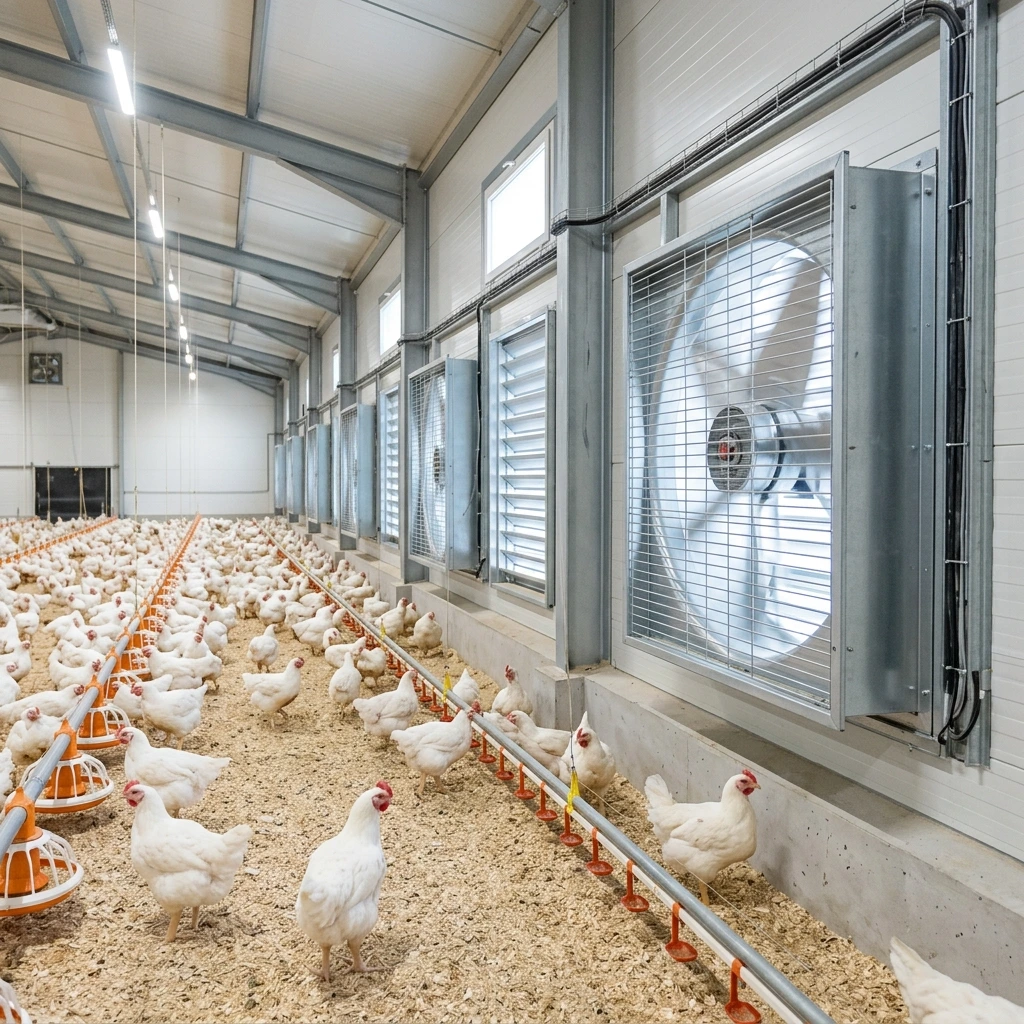
Ventilation is the primary tool for humidity management in poultry sheds. This isn't news to most farmers — but the interaction between ventilation rate and humidity is more nuanced than simply "more ventilation equals less humidity."
At low temperatures, the air's capacity to carry moisture is limited. Increasing ventilation when it's cold brings in cool air that has less moisture-carrying capacity, which can counterintuitively result in the shed feeling more humid at bird level even with higher air exchange rates. This is the core challenge of winter ventilation management — balancing the need to remove moisture against the need to maintain temperature.
At high temperatures, as seen during Madhya Pradesh summers, ventilation becomes critical both for cooling and for moisture removal. Here, the target is high air velocity across the birds rather than just air exchange, and the humidity challenge is less acute because warm air carries moisture effectively.
The practical implication is that there is no single ventilation setting that works across all seasons. Effective humidity management requires seasonal adjustment of ventilation strategies, which in turn requires regular monitoring of actual humidity levels rather than assuming they're acceptable.
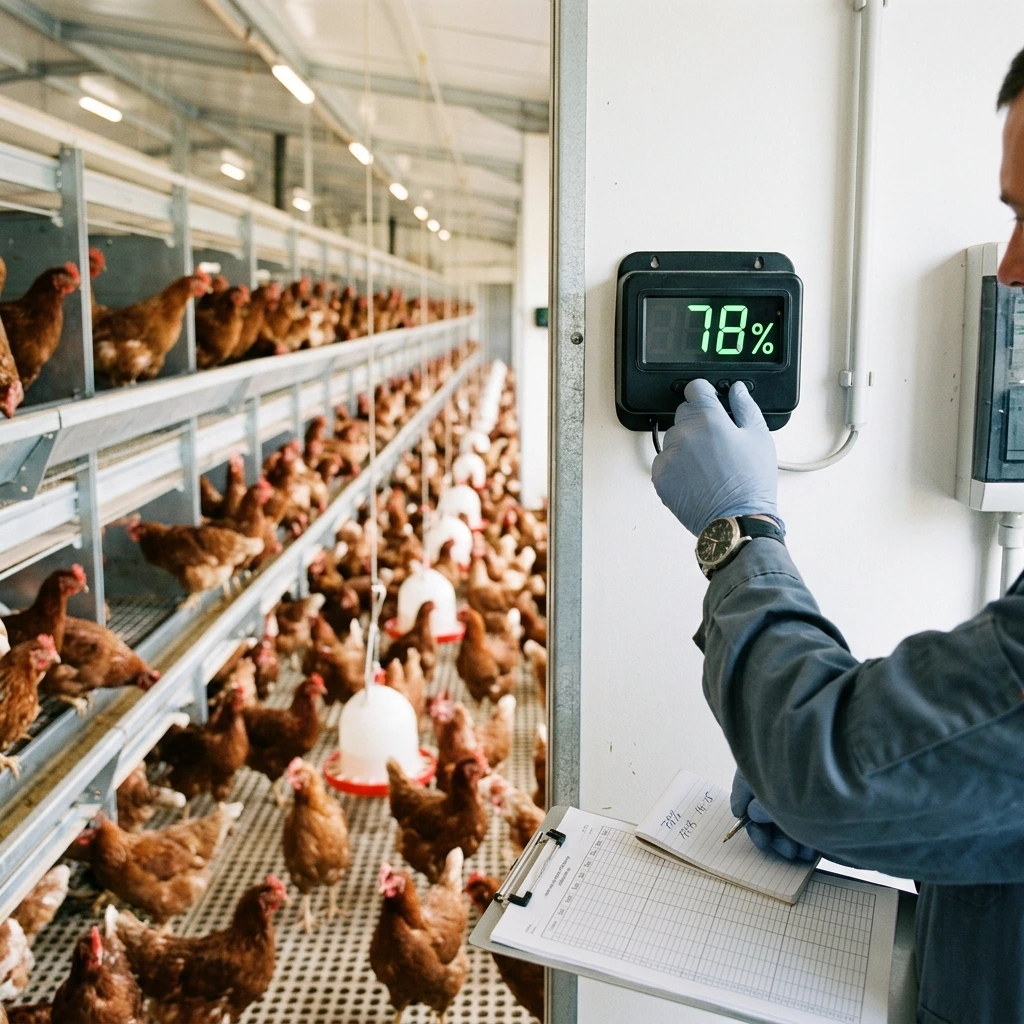
A simple digital hygrometer — available for a few hundred rupees — positioned at bird level gives you the information you need. Without measurement, you're managing humidity by guesswork, which is exactly how humidity problems develop slowly enough to escape notice until they've already done damage.
Litter Management as Humidity Control
It's worth saying explicitly: litter management and humidity management are two sides of the same coin. You can't manage one independently of the other.
The litter in your shed is both a consequence of humidity conditions and a cause of humidity conditions. Wet litter produces moisture through further decomposition. That moisture enters the air and raises relative humidity. Higher relative humidity prevents moisture from leaving the litter. The cycle becomes self-reinforcing.
Breaking the cycle requires intervention at the litter level. This might mean partial litter replacement in severely affected areas, application of litter amendment products to reduce moisture and ammonia generation, or physical turning and aerating of caked litter to break the surface and expose drier material below.
The choice of litter material matters too. Rice husk, which is widely available across Madhya Pradesh and used extensively in our operation, has better moisture-absorbing properties than many alternatives when it's in good condition and at appropriate depth. Thin litter — whatever the material — absorbs moisture quickly and becomes saturated, losing all management value.
Water management and litter hygiene in poultry
Practical Humidity Targets: A Reference
For farmers who want clear numbers to work with, here are the generally accepted ranges based on poultry veterinary guidelines. These should be treated as targets, not guarantees, and adjusted based on observed bird behaviour:
During the first week of brooding, relative humidity between 60% and 70% is appropriate — the higher end of the range supports respiratory mucosa development in very young chicks. From week two onward through the production cycle, 50% to 70% is the standard target. Above 70% for extended periods creates the litter and respiratory risks described above. Below 40% creates dust and desiccation issues.
Monitoring at least twice daily — morning and evening — and recording the values allows you to identify trends before problems develop fully.
FAQ: Humidity in Poultry Farming
What is the ideal humidity level in a poultry shed?
For most of the production cycle, the recommended relative humidity range is between 50% and 70%. During the first week of brooding, slightly higher humidity — around 60% to 70% — is appropriate for young chicks. Prolonged humidity above 70% creates wet litter and respiratory risks.
How does high humidity affect poultry health?
High humidity promotes wet litter, which generates ammonia. Ammonia damages the respiratory mucosa in birds, reducing their natural defence against respiratory pathogens. Wet litter also increases the risk of footpad dermatitis and bacterial infections. Sustained high humidity during brooding can permanently impair a flock's growth and health performance.
How do I lower humidity in a poultry shed?
The primary tools are ventilation to remove moist air, active litter management to keep litter dry, control of drinker equipment to prevent water spillage, and appropriate stocking density. In very humid conditions such as during the monsoon, you may also need to add dry litter material to dilute wet patches and break up caked litter regularly.
Can humidity be too low in a poultry farm?
Yes. Relative humidity below 40% dries out the respiratory mucosa, increases dust levels, and can cause moisture loss in very young chicks during the first days of life. During hot, dry seasons, monitoring for low humidity and taking steps to maintain appropriate levels is as important as managing high humidity.
How do I measure humidity in my poultry shed?
A basic digital hygrometer, which measures both temperature and relative humidity, is a practical tool. It should be positioned at bird level rather than hung high in the shed, as temperature and humidity at the birds' breathing zone are what actually affect them. Records should be kept to identify patterns and seasonal trends.