Why Chick Brooding Is the Most Critical Phase in Poultry Farming
There is a saying among experienced poultry farmers that the first ten days decide the next ten weeks. I've seen this play out more times than I can count — batches that struggled through a poorly managed brooding phase never quite caught up, no matter how good the feed or how clean the shed was afterwards. And batches that were brooded with care, attention, and the right conditions consistently outperformed every expectation.
Chick brooding isn't a preliminary step before the "real" farming begins. It is the foundation on which everything else rests. Get it right and you set your birds up for healthy growth, good feed conversion, and lower losses. Get it wrong and you spend the rest of the production cycle compensating for damage you could have prevented in the first two weeks.
This piece explains exactly why brooding matters so much, what's happening biologically during those early days, and what practical decisions you can make to give your chicks the best possible start.
What Is Chick Brooding and Why Does It Matter?
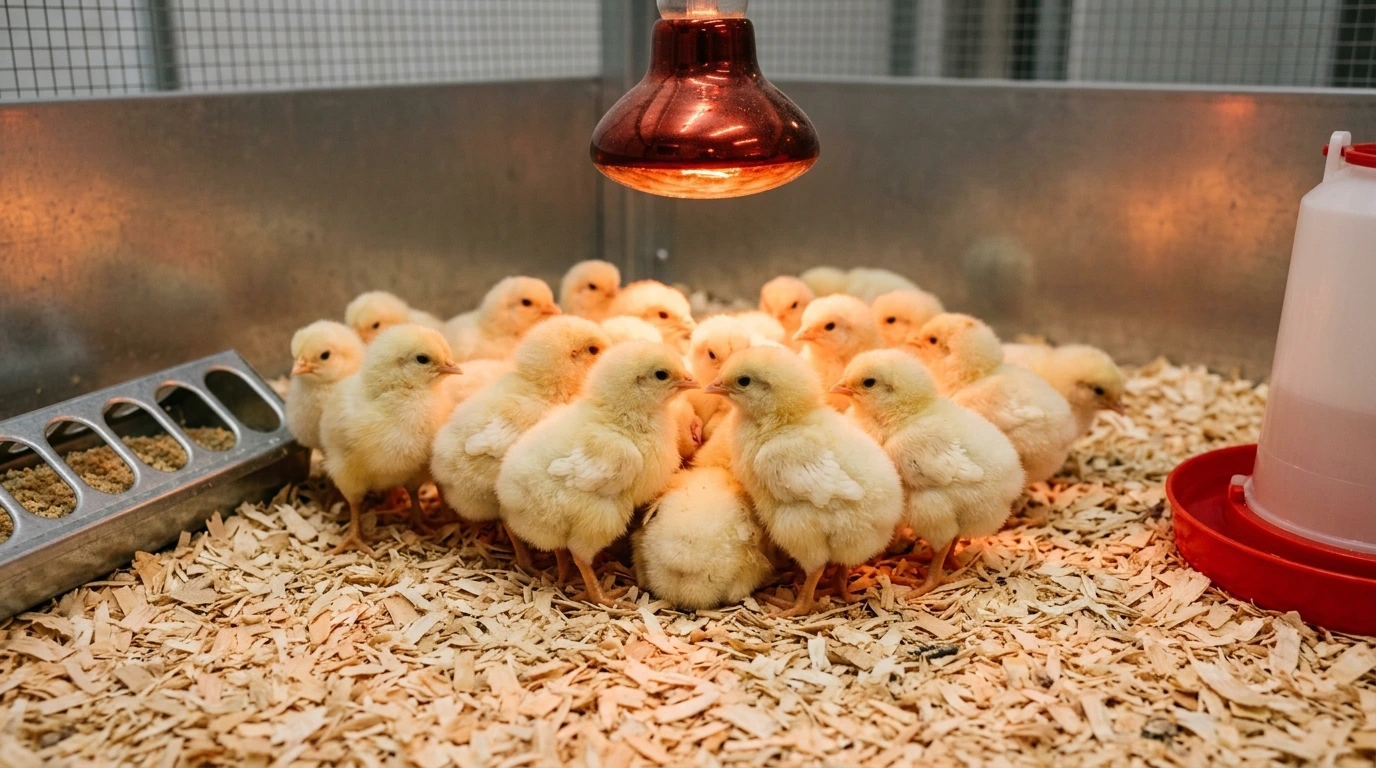
Brooding is the period of intensive care given to day-old chicks during the first two to four weeks of life, when they cannot yet regulate their own body temperature. In natural conditions, a mother hen would provide this warmth by gathering her chicks beneath her wings. In a farm setting — whether you're raising commercial broilers, Sonali desi chickens, or any other breed — you replace that maternal warmth with a controlled brooding environment.
The core challenge is this: a day-old chick has an underdeveloped thermoregulatory system. It can't shiver effectively to generate heat. It can't seek shade to cool down. It is entirely dependent on its environment to maintain the body temperature it needs for basic physiological function. That temperature requirement — typically 32°C to 35°C at chick level in the first week, reducing gradually week by week — isn't optional. It's biological necessity.
But brooding is about far more than just heat.
The Biology Behind Those First Weeks
When a chick hatches, it arrives with a residual yolk sac that provides nutrients for roughly the first 24 to 72 hours of life. During this window, the chick's digestive system is actively developing. The intestinal villi — the tiny projections that absorb nutrients from feed — are forming and maturing. The gut microbiome is being established. The immune system is beginning to develop.
Every stress event during this period — whether from cold, overheating, dehydration, poor ventilation, or crowding — diverts the chick's limited energy away from these critical developmental processes. The gut that was supposed to be developing absorbs nutrients less efficiently. The immune system that was supposed to be strengthening is instead managing a stress response.
This is why early mortality during brooding isn't random. It usually points to specific, identifiable failures in the brooding environment. And the chicks that survive a stressful brooding period but don't die outright often carry the consequences in the form of poor growth rates, reduced feed conversion, and greater susceptibility to disease throughout the production cycle.
Research from the Wageningen University poultry science group has noted that gut development in the first week of life has long-term effects on intestinal surface area and digestive efficiency — effects that are difficult or impossible to reverse later in the cycle.
Temperature: The Most Common Place Brooding Goes Wrong
Ask any experienced poultry farmer what causes the most brooding problems and the answer is almost always temperature management. Not always too cold — sometimes too hot. Both extremes are damaging, and they damage in different ways.
Chicks that are too cold will huddle together directly under the heat source. In severe cases, they pile on top of each other and the birds at the bottom can suffocate. More commonly, cold chicks become quiet and inactive, stop eating and drinking, and use all available energy just maintaining their core temperature. Growth essentially stops. Immunity takes a hit.
Chicks that are too hot will move as far away from the heat source as possible. They pant. They become lethargic. Dehydration sets in quickly. In poorly ventilated sheds, a combination of heat stress and ammonia from early litter decomposition can cause respiratory damage in chicks that are just days old.
The most useful tool for diagnosing temperature problems in a brooding shed is observation, not a thermometer. Thermometers tell you the air temperature at sensor height. What matters is the temperature at chick level, which can differ significantly. And what matters most is how the chicks are behaving. A well-brooded flock spreads evenly across the brooding area, moves actively, eats and drinks readily, and rests in relaxed groups — not tight, frightened huddles.
At Apollo Farm, where we raise Sonali desi chicks which are somewhat hardier than commercial hybrids but still entirely dependent on good brooding in their first week, we check the chick spread pattern every few hours during the first five days. You can't automate good observation.
Water Before Feed — A Priority Most Farmers Get Backwards
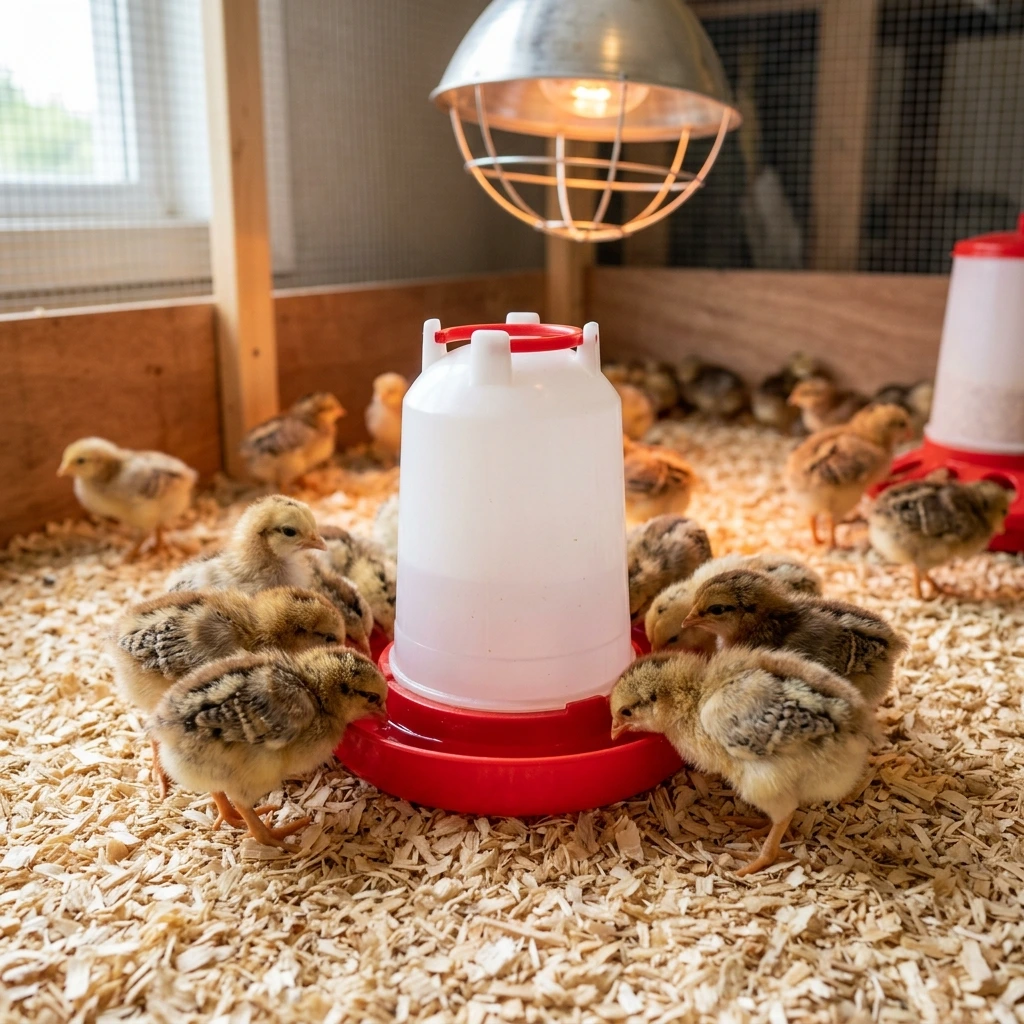
New farmers often think about feed first. The reality of brooding biology puts water first — always.
A day-old chick has just completed a demanding hatching process and may have been in transit for several hours before arriving at the farm. Dehydration is already a risk. The chick's kidneys are immature and poorly equipped to handle extended water deprivation. When chicks are dehydrated at arrival, they don't eat properly even when feed is available, because the digestive process requires adequate hydration to function.
The standard recommendation from poultry veterinary literature is to ensure clean, fresh water is available at chick level before birds are placed, and that the water temperature is not cold enough to cause thermal shock — water that's been sitting in a cold shed overnight can create a secondary stress response in chicks placed in it immediately.
Electrolyte supplementation in drinking water during the first 24 to 48 hours is a common and effective practice for supporting chicks through the stress of transit and placement, and for stimulating early water intake. This isn't a luxury for commercial operations — it's a practical intervention with measurable effects on early survival and development.
Ventilation: The Underrated Brooding Factor
Every brooding guide talks about temperature. Far fewer emphasise ventilation adequately. But chicks breathing in excessive ammonia during their first week of life suffer real and lasting respiratory damage — damage to the mucous membranes of the respiratory tract that reduces the natural barrier function those membranes provide against respiratory pathogens.
Ammonia buildup in brooding sheds comes from litter decomposition, which begins almost immediately. Wet litter, poor drainage, and inadequate air exchange accelerate this process. The challenge is that ventilation requirements must be balanced against temperature maintenance — too much fresh air flow and you create cold drafts; too little and ammonia accumulates.
Managing this balance is one of the practical skills that experienced poultry farmers develop over time. It involves controlling the height and placement of ventilation openings, managing litter moisture actively, and understanding how shed design affects air movement. There is no single formula that works for every shed design in every climate — which is part of why good brooding is a skill, not just a procedure.
Brooding Sonali Desi Chicks: Some Specific Considerations
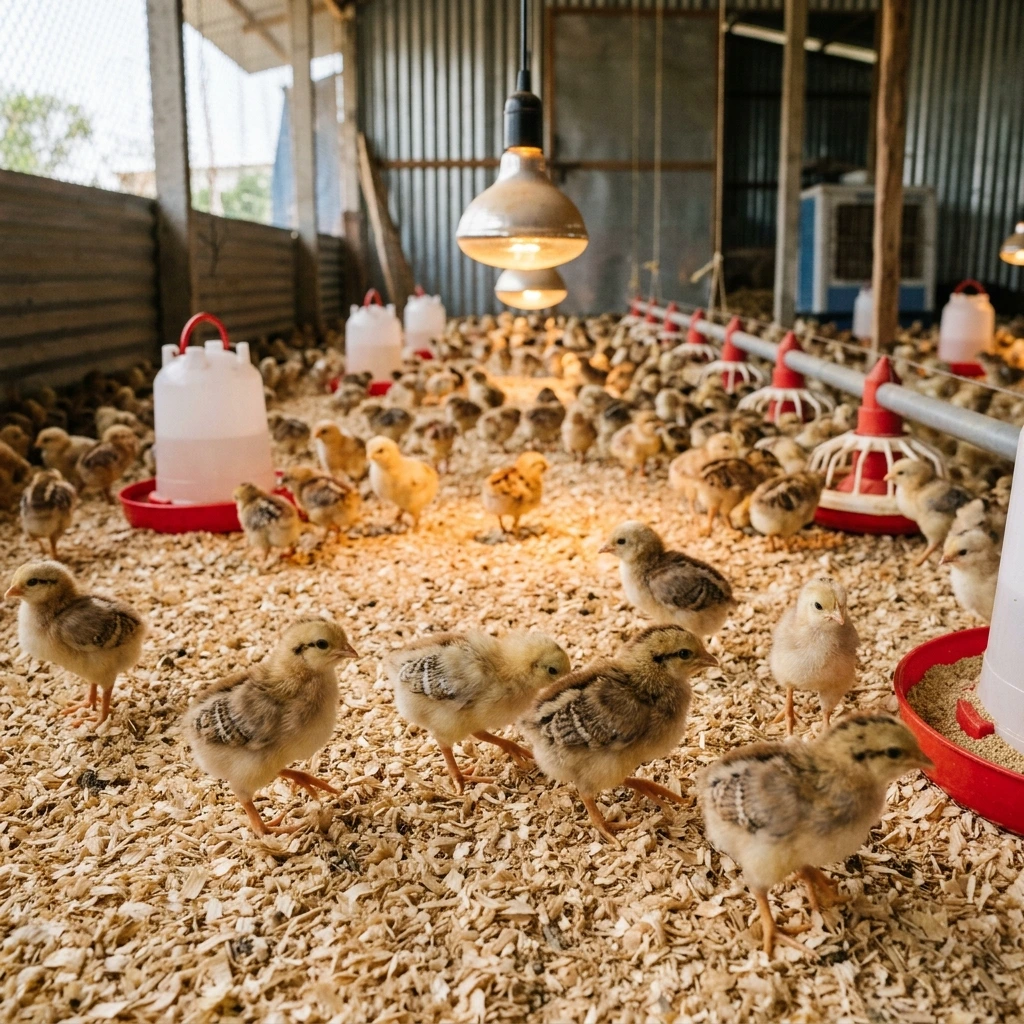
Sonali chickens — the indigenous-heritage cross breed that has become central to desi chicken farming across India — are naturally hardier and more disease-resistant than many commercial broiler breeds. Their immune systems tend to establish more robustly and their tolerance for environmental variation is greater in later weeks of production.
But at day one, a Sonali chick requires the same quality of brooding care as any other breed. The genetic robustness that makes Sonali birds attractive for semi free-range production doesn't express itself until the birds are several weeks old and their systems have had time to develop. In the brooding phase, they are just as vulnerable to temperature stress, dehydration, and poor gut development as any other chick.
What does differ slightly in Sonali brooding practice is the transition out of the brooding phase. Because Sonali birds are being raised for traditional, firm-textured meat production and are often intended for a semi free-range system, the acclimatisation period — when birds are gradually exposed to environmental variation as heat sources are reduced — can be managed with slightly more flexibility than with commercial hybrids that are raised in fully controlled indoor environments throughout their cycle.
The Connection Between Brooding and Antibiotic Use
This is a point that deserves direct attention, particularly for farms committed to reduced or zero routine antibiotic use.
The majority of early-cycle disease events that trigger antibiotic intervention in poultry production — respiratory infections, yolk sac infections, early gut health problems, E. coli challenges — have a significant brooding management component. Poor temperature management stresses immune development. Poor water quality at placement increases gut pathogen load. Poor ventilation creates respiratory vulnerability. In many cases, a disease event in week two or three that results in antibiotic treatment can be traced back to a brooding failure in week one.
This is not a minor point for farms in Madhya Pradesh or anywhere in India that are trying to move toward antibiotic-reduced production models. You cannot sustainably reduce antibiotic dependence if your brooding management is creating the conditions for the diseases those antibiotics are treating.
Good brooding is, in practical terms, one of the most cost-effective disease-prevention investments a farm can make.
Common Brooding Mistakes and How to Avoid Them
Now, here is the thing about brooding mistakes — most of them are not complicated errors. They're the result of small oversights that compound quickly in the first week of a chick's life.
Starting the brooder too late is one of the most common. The brooding area needs to be at the correct temperature before the chicks arrive, not being heated up while birds are already under stress from placement. Depending on the shed size and brooder type, pre-heating can take several hours.
Ignoring litter moisture in the first few days is another. Early litter wetness often comes from drinker spillage, and it starts the ammonia-generation cycle and creates a wet, cold environment that directly contradicts the thermal management effort being put into the brooder above.
Using equipment that's inadequate for the shed volume is a third. Undersized heat sources create uneven temperature distribution, with warm zones directly under the brooder and cold zones everywhere else — a setup that creates crowding, competition for heat, and the associated problems of chick piling.
And perhaps most commonly, not adjusting the brooding environment as chicks grow. The temperature requirement drops by approximately 2°C to 3°C each week during the brooding phase. Maintaining the same heat input into week three that was appropriate in day one creates heat stress in older, more active birds.
FAQ: Chick Brooding in Poultry Farming
How long does the brooding period last for chicks?
The brooding period typically lasts between two and four weeks, depending on the breed, climate, and the rate at which the shed temperature is being reduced. Sonali desi chicks in warmer climates like Madhya Pradesh may transition out of the active brooding phase earlier than breeds raised in colder environments.
What temperature should a chick brooder be set to?
At chick level, the brooding temperature should be approximately 32°C to 35°C in the first week, reducing by around 2°C to 3°C per week thereafter. The most reliable guide is chick behaviour — well-brooded chicks spread evenly across the brooding area and are active and alert.
Why are my chicks huddling together under the brooder?
Huddling directly under the heat source is the most common behavioural sign of cold stress. The brooding temperature is likely too low, there may be cold drafts entering the shed, or the heat source may be insufficient for the number of birds or shed size.
What is the first thing chicks need when they arrive at the farm?
Clean, fresh water at an appropriate temperature should be available before chicks are placed. Water before feed is the standard priority — dehydration from transit is a common early stressor, and adequate hydration is necessary for the digestive system to function properly when feed is introduced.
Can brooding mistakes affect the entire production cycle?
Yes. Research consistently shows that gut development, immune system establishment, and overall physical development during the first two weeks have lasting effects on growth rate, feed conversion efficiency, and disease resistance throughout the production cycle. Brooding problems rarely stay confined to the brooding period.