Sonali Chicken: The Desi-Style Chicken That Combines Taste, Quality and Modern Poultry Farming
If you ask someone in India what kind of chicken they prefer, you will usually get two very different answers. At Apollo Farm, this is exactly why we chose Sonali for our poultry operation.
Some people choose broiler chicken because it is affordable, tender and cooks quickly. Others prefer desi chicken because of its stronger flavour, firmer meat and traditional eating experience.
Then there is Sonali chicken—a bird that sits somewhere between the two.
Sonali has become popular because it offers something many customers are looking for: the appearance and eating experience of traditional chicken, combined with the practical advantages of a commercially raised bird.
Where Did Sonali Chicken Come From?
Despite its popularity in India today, Sonali chicken did not originally come from India.
The Sonali is a cross between a Rhode Island Red (RIR) male and a Fayoumi female, developed in Bangladesh. The Fayoumi contributed characteristics associated with adaptability and hardiness, while the Rhode Island Red brought useful meat-and-egg production traits.
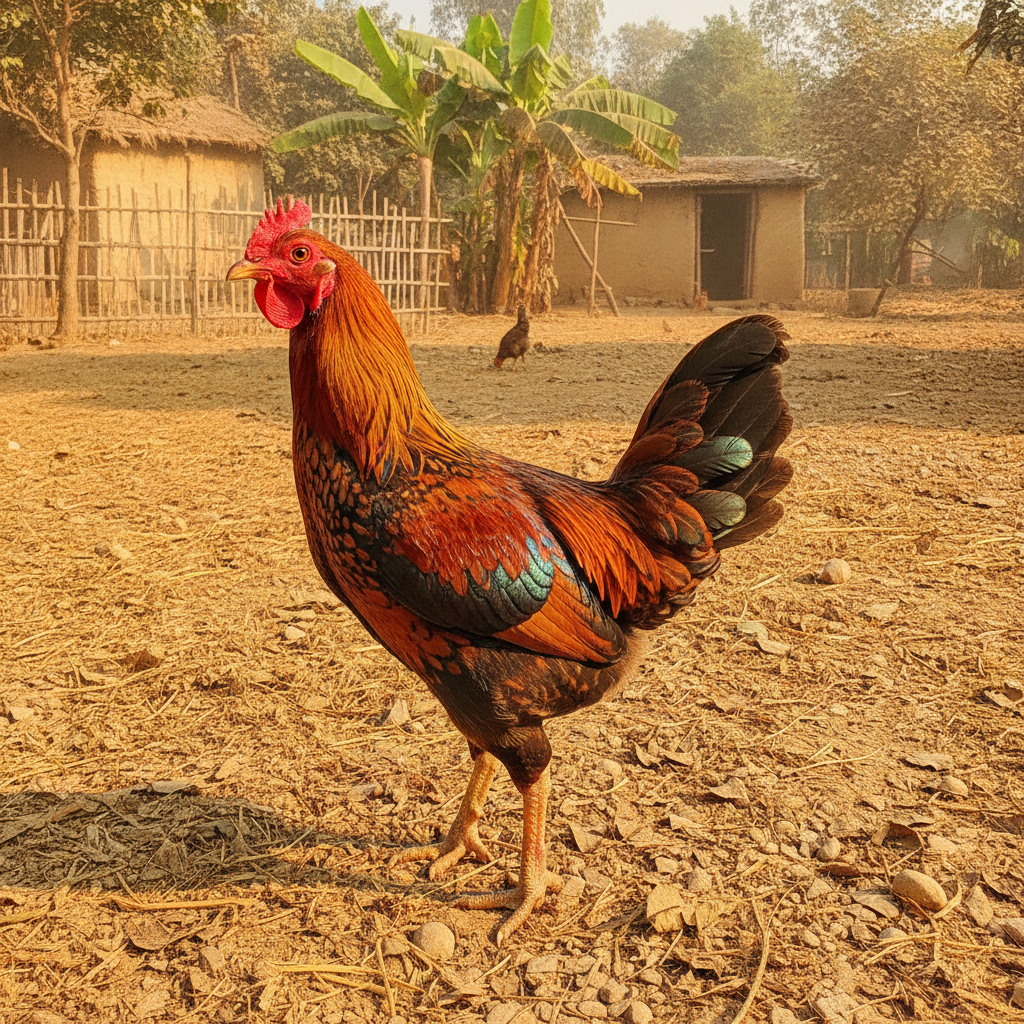
The resulting bird has a colourful, golden-brown appearance that looks much closer to traditional country chicken than the familiar white commercial broiler. Research literature describes Sonali as a crossbred bird with a phenotype similar to local indigenous chickens.
Sonali became particularly important in Bangladesh, where it developed a strong consumer market and became an important part of rural and commercial poultry farming. Studies have reported strong consumer preference for Sonali over conventional broilers, especially because of its appearance and meat characteristics.
What about India?
There is no reliable, authoritative source that gives one exact year when the meat-type Sonali was first introduced into India. So we would rather not invent a date simply for marketing.
What is clear is that Sonali is now commercially available in India, particularly in eastern and northeastern markets, and Indian poultry suppliers and farms are actively raising and selling Sonali birds.
It is also important not to confuse this Sonali with CARI Sonali Layer / Golden-92, an Indian layer strain developed at ICAR-CARI. The meat-type Sonali discussed here is the RIR × Fayoumi cross associated with Bangladesh.
Why Does Sonali Look Like Desi Chicken?
This is one of the biggest reasons customers notice Sonali.
A commercial broiler usually has a broad body, heavy breast and mostly white feathers. Sonali birds, on the other hand, have colourful feathers, a more traditional body shape and a golden/brown appearance.
That appearance immediately reminds many customers of the chicken they grew up eating.
But Sonali is not a pure desi chicken.
It is a crossbred bird created to combine useful production characteristics with a more traditional-looking appearance.
That distinction is important.
Does Sonali Chicken Taste Like Desi/Gauran Chicken?
This is where Sonali becomes interesting.
If you have eaten traditional Gauran/desi chicken, you already know that its meat usually has a stronger flavour and firmer texture than commercial broiler meat.
Sonali does not taste exactly the same as a fully indigenous desi bird—but it can come closer to the traditional chicken eating experience than a conventional broiler.
Research comparing indigenous/desi, Sonali and broiler meat found differences in meat composition, texture and sensory characteristics. In that study, desi chicken had stronger flavour than broiler, while Sonali occupied an intermediate position in several characteristics.
So if we had to describe it simply:
Broiler → softer, milder, more tender
Sonali → firmer, more flavourful, more traditional
Pure desi → strongest traditional character, but usually slower-growing and less meat-efficient
That is one reason Sonali appeals to customers who want something closer to desi chicken without paying the full price—or waiting as long—for a traditional bird.
Sonali Chicken vs Broiler Chicken
This is not really a case of one being “better” at everything.
They are bred for different purposes.
Broiler chicken
Broilers are specifically selected for rapid growth and efficient meat production. They reach market weight much faster than Sonali and generally produce more breast meat and higher carcass yield.
That makes broiler chicken excellent for affordable, high-volume meat production.
Sonali chicken
Sonali grows more slowly, but that slower growth is part of what creates its different characteristics.
Research comparing Sonali and broilers has found that broilers have higher growth and carcass performance, while Sonali is valued for consumer preference, appearance and different meat characteristics.
So why would anyone pay more for Sonali?
Because customers are not buying kilograms alone—they are buying taste, texture and preference.
Sonali vs Broiler: At a Glance
| Feature | Sonali | Commercial Broiler |
|---|---|---|
| Growth speed | Moderate | Very fast |
| Appearance | Colourful / desi-like | Usually white |
| Meat texture | Firmer | Softer / more tender |
| Flavour | More pronounced | Milder |
| Resembles traditional chicken | More closely | Less closely |
| Market price | Usually higher | Usually lower |
| Meat production efficiency | Lower | Higher |
| Consumer positioning | Premium / desi-style | Mass-market |
| Purpose | Meat + dual-purpose heritage | Primarily meat |
So if your only goal is maximum kilograms of meat in the shortest possible time, broiler wins.
If your goal is a differentiated chicken with a more traditional eating experience, Sonali becomes much more interesting.
What About FFG, Kuroiler, DP and DP Cross?
Customers often ask us this because there are now many coloured and desi-type chickens available in India.
The comparison needs some care.
Kuroiler is a recognized Indian poultry strain developed for meat and egg production and adapted to alternative/free-range-type production systems. There is also a commonly marketed Kuroiler FFG strain. Scientific literature has specifically studied Kuroiler FFG chicks under Indian conditions.
FFG is also used in the Indian market to describe faster-growing free-range/coloured birds, and the terminology is not always used consistently by different hatcheries.
DP and DP Cross are widely used names in the Indian desi-poultry market, particularly among smaller hatcheries and farmers, but they do not have the same standardized genetic definition across suppliers. That means two birds sold as “DP Cross” may not necessarily have identical genetics or performance.
Therefore, it would be misleading to publish a table saying “Sonali is 20% better than DP” or “Sonali grows faster than FFG” without testing the actual strains under the same conditions.
In practical terms:
- Broiler: best when rapid meat production is the priority.
- Kuroiler/FFG: attractive for farmers looking for coloured, hardy, dual-purpose or free-range-oriented birds.
- DP/DP Cross: can be useful for desi-style farming, but performance depends heavily on the actual genetic cross supplied.
- Sonali: attractive when the target customer wants a colourful, desi-looking bird with a traditional-style meat experience and commercial availability.
For Apollo Farm, that last category is the one we want to serve.
Why Is Sonali Chicken More Expensive Than Broiler?
This is a simple question with a simple answer:
Sonali costs more because it costs more to produce.
A broiler is designed to grow extremely quickly. The farmer can raise, sell and replace the flock in a relatively short production cycle.
Sonali takes longer to reach market weight. That means:
- More days of labour
- More days of housing
- More feed
- More water
- More management
- Higher cost per bird
- Slower turnover of capital
There is another side to the equation: consumer demand.
When customers are willing to pay more for Sonali because they prefer its appearance and eating quality, the market supports a higher selling price.
Studies in Bangladesh have found that Sonali commands higher prices than broiler and that consumer preference contributes to its economic attractiveness.
So the higher price does not simply mean that the farmer is charging more.
The bird itself takes more time and money to produce, and customers value the product differently.
Why Does Apollo Farm Choose Sonali?
At Apollo Farm, we did not choose Sonali because it is the fastest-growing chicken.
It isn't.
We chose it because we believe there is a gap between cheap commercial broiler chicken and expensive traditional desi chicken.
Sonali fits that gap.
Our aim is to offer customers a chicken that has:
Desi-style appearance + better meat character + modern poultry management + farm-direct supply.
How We Raise Sonali Chickens at Apollo Farm
Our approach is based on semi-free-range and natural farming practices.
We want our birds to have space to move, access to open ground where appropriate, and a clean and well-managed environment.
We also make use of farm-grown resources such as:
Moringa
Moringa leaves are grown on the farm and used as part of our broader integrated farming system.
Azolla
Azolla is cultivated on the farm and used as a supplementary feed ingredient.
Black Soldier Fly Larvae
BSF larvae provide another locally produced protein source that can be incorporated into poultry nutrition.
These ingredients are supplements to a properly balanced poultry diet—not replacements for complete poultry nutrition.
Our objective is to make better use of natural farm resources while still maintaining proper poultry nutrition.
No Routine Antibiotics
At Apollo Farm, we do not use antibiotics routinely simply to promote growth or as a substitute for good management.
Our focus is on:
- Good biosecurity
- Vaccination
- Clean water
- Proper nutrition
- Clean housing
- Good ventilation
- Disease prevention
- Regular flock observation
If a bird becomes sick, responsible poultry farming requires appropriate veterinary assessment and treatment where necessary. “No routine antibiotics” is therefore a more accurate description of our approach than claiming that a commercial poultry farm can guarantee that no bird will ever receive antibiotics under any circumstance.
Is Sonali Chicken Healthier Than Broiler?
This is another claim we don't want to exaggerate.
Sonali is not automatically “healthier” than broiler simply because it is Sonali.
Nutrition depends on breed, age, feed, farming system, and the particular cut of meat.
Research has found differences between Sonali and broiler meat in protein, fat and other meat-quality characteristics, but those differences should not be turned into a blanket claim that one chicken is universally healthier.
What we can confidently say is that Sonali provides a different eating experience and a different production system from conventional broiler chicken.
And for many customers, that difference matters.
Why Sonali Is Special to Apollo Farm
For us, Sonali is not just another poultry breed.
It represents the kind of farming we want Apollo Farm to be known for.
We want to combine traditional food preferences with modern farming knowledge.
We want our customers to know where their chicken came from.
We want them to be able to visit the farm, see how the birds are raised, understand what we feed them, and buy directly from the people who raised them.
That is why we call our approach:
Naturally Raised. Farm Direct. Growing Excellence, Naturally.
Final Thoughts: Is Sonali Chicken Worth Trying?
If you want the cheapest chicken and the fastest cooking time, conventional broiler chicken will probably remain your better choice.
But if you enjoy the taste and texture of traditional desi/Gauran chicken, while still wanting a commercially available bird with better meat yield and a more manageable price than pure desi chicken, Sonali is worth trying.
It isn't a pure desi chicken.
It isn't a broiler.
It is Sonali—and that is exactly what makes it interesting.
At Apollo Farm, Bhopal, we raise Sonali chickens with a focus on responsible management, balanced nutrition, natural farm resources, good biosecurity and farm-direct sales.
Come taste the difference for yourself.