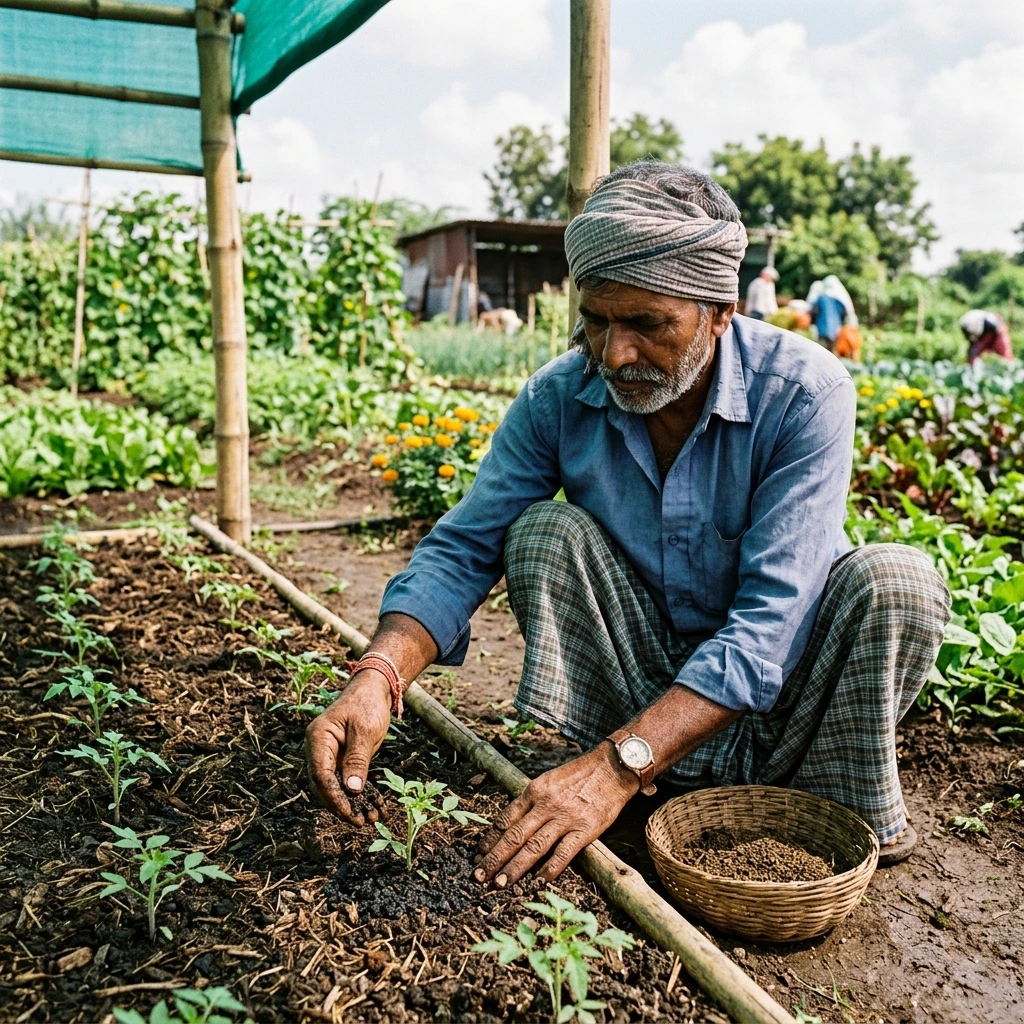
I want to tell you about a conversation I had with a neighbouring farmer about two years ago.
He'd been composting with earthworms for years — vermicompost, the old reliable. Beautiful dark stuff, smelled like good earth, and his vegetables had always done well. Then someone mentioned BSF frass to him. Black Soldier Fly frass. He'd never heard of it. He called it "that insect dirt" and was mildly horrified.
Six months later, he called me. He'd tried the frass on one section of his garden and the vermicompost on another. "Both worked," he said. "But they worked differently."
That's the thing nobody tells you about this comparison. It isn't a knockout contest. It's more like comparing a scalpel and a hammer — both useful, both legitimate, and which one you reach for depends entirely on what you're trying to do.
Let's get into it properly.
What Is BSF Frass, Exactly?
If you're new to Black Soldier Fly farming, here's the short version. Black Soldier Fly larvae — Hermetia illucens — are voracious decomposers. They'll eat kitchen scraps, manure, agricultural waste, and organic material that most other organisms won't touch. What they leave behind after processing that material is called frass.
Frass is a combination of larval excrement, shed exoskeletons, and the partially broken-down organic matter the larvae have moved through. It sounds unpleasant. It looks like fine, dark, crumbly material. And it is, nutritionally speaking, remarkably concentrated.
The numbers vary depending on what the larvae were fed, but BSF frass typically contains nitrogen levels in the range of 2% to 6%, phosphorus around 3% to 5%, and potassium in the 1% to 3% range. Those are decent figures for a primary fertilizer. But what makes frass genuinely interesting is what else it contains — chitin.
Chitin is the structural compound found in insect exoskeletons. When you apply frass to soil, that chitin interacts with soil bacteria in a fascinating way. The bacteria that break down chitin — chitinolytic bacteria — happen to be the same bacteria that suppress soil-borne pathogens like Fusarium and Pythium, which cause root rot and damping-off diseases in plants. In other words, applying frass may actively improve your soil's disease-suppression capacity. Not just feed your plants — protect them.
That's not marketing. That's biology.
And Vermicompost — The One Everyone Already Knows
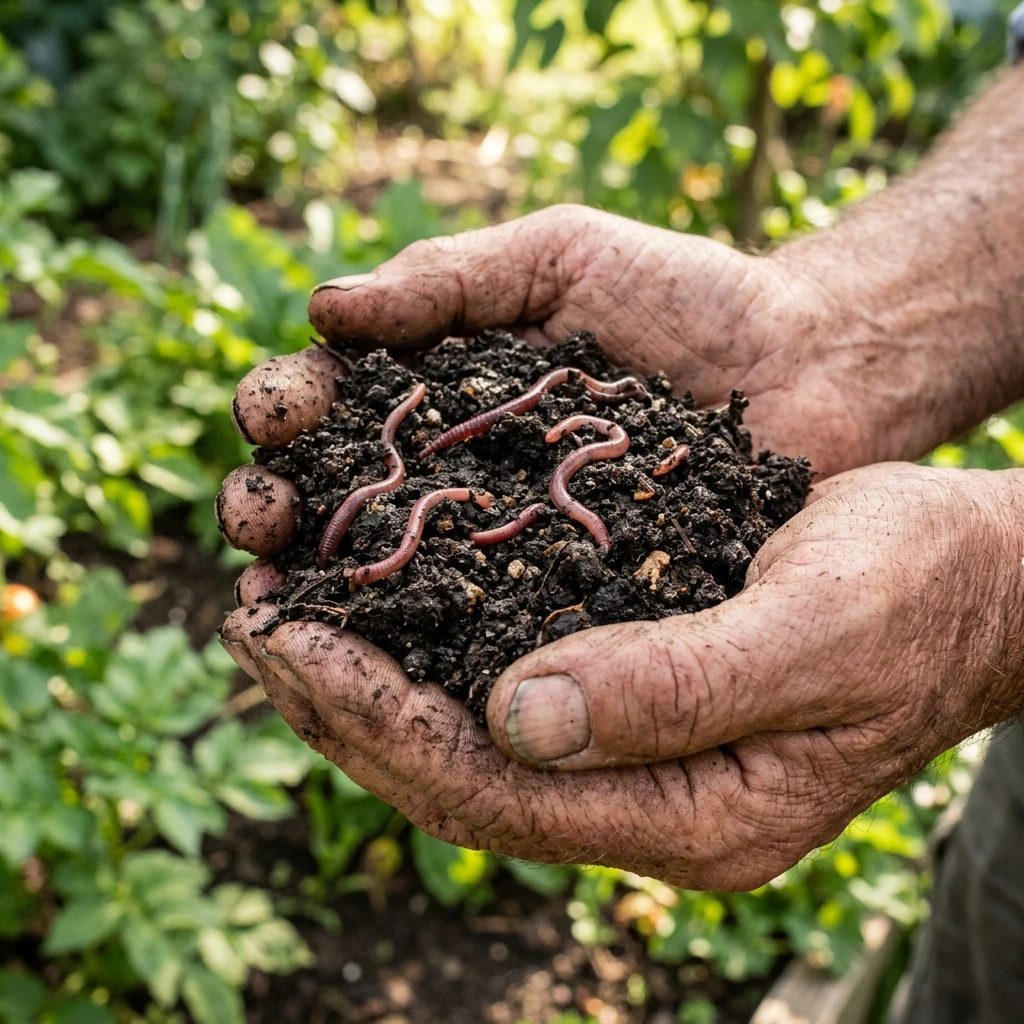
Vermicompost has been around forever, relatively speaking. The process is simple: earthworms eat organic matter and their castings are the product. Worm castings are extraordinarily biologically active — packed with beneficial microorganisms, humic acids, and plant growth hormones like auxins and gibberellins.
The NPK of vermicompost tends to be lower than frass on paper — typically nitrogen around 1% to 3%, phosphorus 1% to 2%, potassium 1% to 2%. But those numbers underrepresent the actual value, because the form in which vermicompost delivers its nutrients is highly plant-available. The worms essentially pre-digest and stabilise the material in a way that makes it exceptionally gentle and slow-releasing.
Vermicompost also brings extraordinary microbial diversity to your soil. A teaspoon of good vermicompost contains millions of bacteria, fungi, protozoa, and nematodes. It doesn't just feed the plant — it feeds the entire soil ecosystem, which then feeds the plant. The distinction matters. You can tell the difference when you open a bag of good, mature vermicompost. It smells like a forest floor after rain. Dark, earthy, alive.
The Head-to-Head: Where Each One Wins
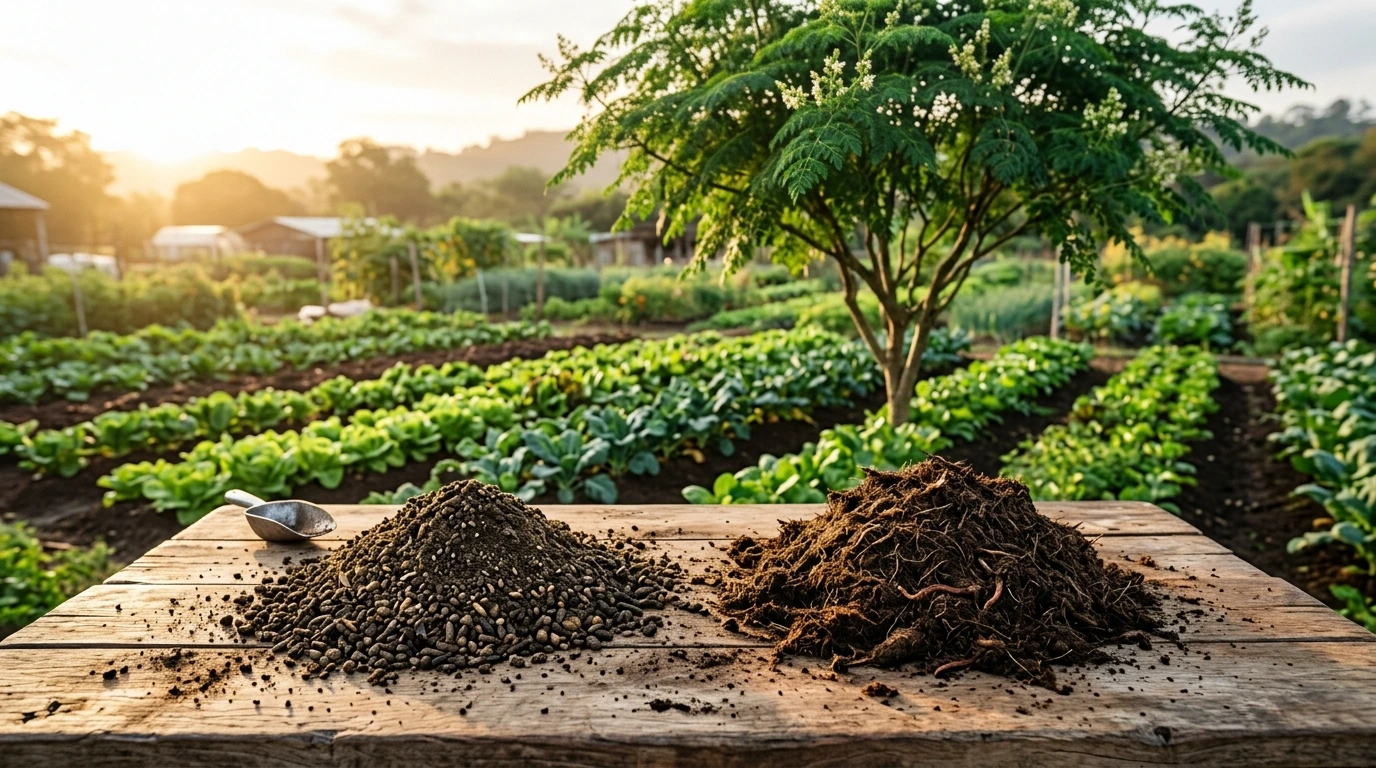
Now, here is the thing. If you ask most people "which is better," they'll pick a side and defend it. But the honest answer is that frass and vermicompost excel in different areas, and understanding those differences makes you a much smarter user of both.
For fast, visible results: BSF frass tends to win. The higher nitrogen and phosphorus concentrations, combined with chitin's biostimulant effects, produce visible growth responses relatively quickly. If you've just transplanted seedlings or you need to correct a deficiency fast, frass is your more powerful lever. It's the more intense input.
For long-term soil health: Vermicompost has the edge. Its slow-release profile, its extraordinary microbial load, and its humic acid content build soil structure and biology in a way that frass alone doesn't replicate. Farmers who've been using vermicompost for years talk about their soil differently — it holds moisture better, it doesn't compact as easily, the earthworm population in the field increases naturally. That's systemic improvement, not just a feeding schedule.
For disease suppression: This is genuinely where frass stands out. The chitin mechanism is real, and there's growing research behind it. If you're dealing with persistent fungal issues, if your seedlings have a history of damping-off, or if you're farming in conditions where root rot is common — adding frass to your soil amendment programme makes specific biological sense.
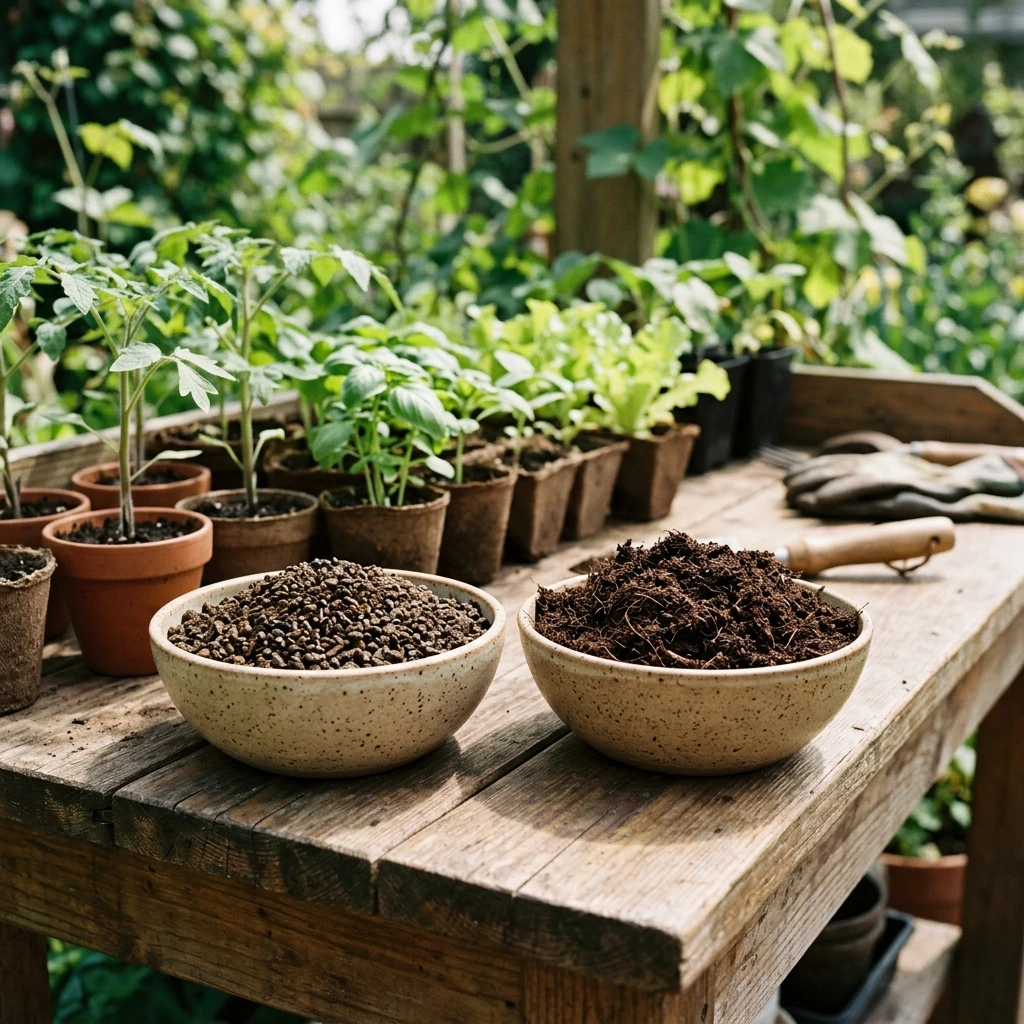
For seedling mixes and delicate plants: Vermicompost. It's gentler, less likely to burn roots, and its microbial content establishes plant-soil relationships early that benefit the plant throughout its life. Mixing even 10% to 20% vermicompost into a seedling medium changes the trajectory of young plants in ways that are visible within weeks.
What Happens When You Use Both?
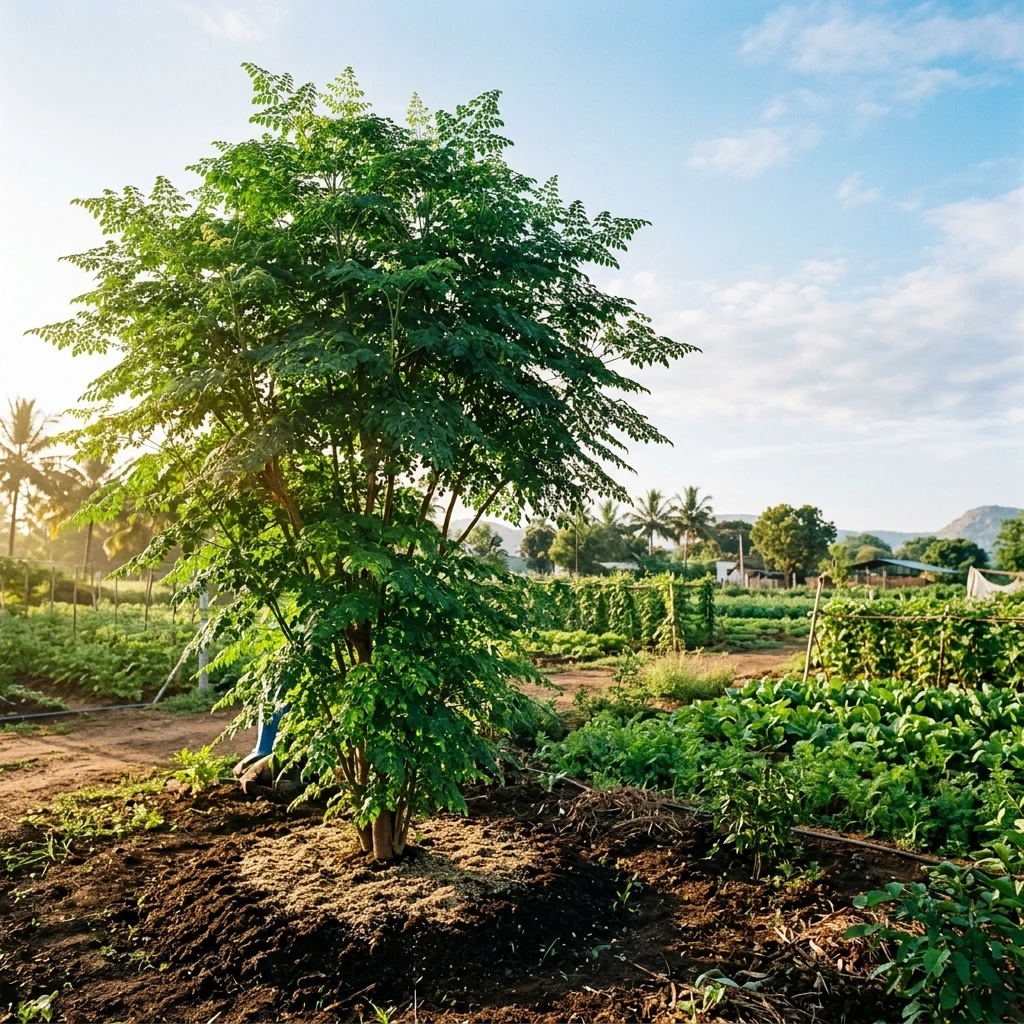
We actually do this at Apollo Farm. Our Moringa trees get a base dressing of vermicompost — the slower, deeper input — and a frass top-dressing during the active growth phase when we want to push leaf production for our birds' feed supplement programme. It's not either-or. It's sequencing.
The results have been consistently good enough that we haven't changed the approach in over a year. The Moringa grows vigorously, the leaf quality is excellent, and the soil under those trees has visibly improved in texture and colour compared to sections that received only single-input amendments.
I won't pretend we've done controlled scientific trials. We haven't. But fifteen years of watching plants grow and soil respond teaches you to read what's working, and this combination works.
The Practical Reality — Cost and Availability
Let's be honest about the real-world picture, because organic farming decisions don't happen in a laboratory.
Vermicompost is widely available across India. You can buy it commercially, make it yourself with a modest investment in a bin and a starter culture of Eisenia fetida worms, and the raw materials — kitchen waste, crop residue, cattle dung — are available on most farms. Cost to produce your own: very low once established.
BSF frass is a newer commodity in the Indian market. Commercial availability is improving, particularly in states with active BSF farming operations. But it's still less widely available than vermicompost, and commercial prices can be higher. If you're running your own BSF unit — for protein feed production, as we do — the frass is essentially a free by-product. If you're buying it, factor in that cost against the benefits.
There's also the production scale question. A well-managed vermicompost bed can produce substantial quantities. BSF frass production is tied to your colony size and the volume of organic waste you're processing. On a small farm, vermicompost may simply be more scalable.
A Note on Application Rates
Both materials are forgiving, but frass is more concentrated and should be applied at lower rates than vermicompost to avoid over-application. General guidance for frass is 200 to 400 grams per square metre as a soil amendment, or up to 10% inclusion in potting mixes. Vermicompost can be applied more generously — anywhere from 500 grams to several kilograms per square metre for established beds, and up to 30% to 40% in seedling mixes without issue.
Both benefit from being worked into the soil rather than left on the surface, where their microbial activity is most effective where soil moisture and organic matter interact.
So — Which One Wins?
Neither. And both. Depending on what you're growing, what problem you're trying to solve, and what your production system looks like.
If I had to choose just one because I could only afford or produce one — and the question was about long-term soil health on a farm that needed to sustain productivity over years — I'd choose vermicompost. Its contribution to living soil ecology is hard to replicate.
If the question was about fast establishment, disease suppression in a high-risk environment, or maximising output from a BSF system I was already running for protein — frass wins that conversation.
But the best farmers I know don't think in either-or terms. They think in what-does-this-soil-need-right-now terms. And often, the answer is a bit of both, applied in the right sequence, at the right rate, to the right crop.
That's not a cop-out. That's just how good farming works.