
How Avian Influenza Spreads to Humans and What You Need to Know
The phrase “bird flu” tends to trigger one of two reactions in people. Some dismiss it entirely — it’s a bird disease, they think, nothing to do with them. Others panic at the first news report. Neither response is particularly useful, and both miss what actually matters.
The truth about avian influenza and its relationship to human health sits somewhere between those extremes. The risk to most people in most circumstances is genuinely low. But the disease is real, the mechanisms by which it crosses from birds to people are well understood, and knowing the facts makes you a more informed farmer, a more careful handler of poultry, and a more sensible consumer of news when the next outbreak headline appears.
What Avian Influenza Actually Is
Avian influenza is caused by influenza A viruses — the same broad family of viruses responsible for seasonal human flu. But avian strains are adapted to birds, not people. They circulate naturally in wild waterfowl, particularly ducks and shorebirds, which often carry them without showing signs of illness.
The problem arises when these viruses reach domestic poultry — chickens, turkeys, ducks kept commercially or on small farms. Domestic poultry, unlike wild waterfowl, are not evolutionarily adapted to these viruses, and the consequences in a flock can range from mild illness to complete collapse of the entire flock within days.
Strains are classified as either Low Pathogenic Avian Influenza (LPAI) or Highly Pathogenic Avian Influenza (HPAI). Low pathogenic strains cause mild symptoms in birds and limited concern in humans. Highly pathogenic strains — H5N1 being the most widely known — cause severe, often fatal disease in birds and, in cases of direct human exposure, can cause serious illness in people as well.
How Does Bird Flu Cross to Humans?
This is the question that matters most, and the answer is more specific than most people expect.
Avian influenza viruses don’t spread easily to humans. They’re adapted to bind to receptors found in avian respiratory tracts, not human ones. For a virus to infect a person, that person generally needs close, direct contact with infected birds or heavily contaminated environments — not casual proximity, and not well-prepared cooked food.
The routes of transmission from birds to humans, as documented in confirmed cases globally, involve direct contact with the blood, faeces, secretions, or respiratory droplets of infected birds. This happens most commonly during slaughter, processing, and handling of sick or dead birds — situations where people are in direct, prolonged physical contact with infected material. Visiting a market where infected live birds are sold, particularly in conditions of poor hygiene, also carries risk.
The WHO and FAO have consistently found that the virus does not spread efficiently through properly cooked poultry meat. Heat destroys the virus. A well-cooked piece of chicken — regardless of whether it came from an infected flock — poses no documented risk of avian influenza transmission.
What Happens When a Human Is Infected
Human cases of avian influenza are relatively rare globally, but when they do occur, the disease can be serious. Symptoms typically resemble severe human influenza: high fever, cough, sore throat, muscle aches, and in serious cases, pneumonia and acute respiratory distress.
H5N1, the strain that has caused most documented human deaths globally, has a case fatality rate that is significantly higher than seasonal flu in reported human cases. However, this number reflects only confirmed clinical cases — people sick enough to reach hospitals — and likely overstates the true infection fatality rate, since many mild or asymptomatic infections may go undetected and unreported.
H5N2 and H7N9 are other strains that have caused human infections. H7N9 in particular caused significant concern in China between 2013 and 2017, with hundreds of confirmed human cases.
The critically important point — confirmed repeatedly by the WHO and global health agencies — is that avian influenza does not currently spread efficiently between humans. The cases that occur are almost entirely the result of direct animal-to-human transmission. Sustained human-to-human transmission has not been established for any current strain, which is why bird flu has not caused a human pandemic despite existing for decades.
Who Is Most at Risk?
The people at greatest risk of avian influenza exposure are those with occupational contact with poultry — farmers, slaughterhouse workers, live bird market vendors, and veterinarians. This is not a disease that spreads through eating properly cooked food or living near a farm.
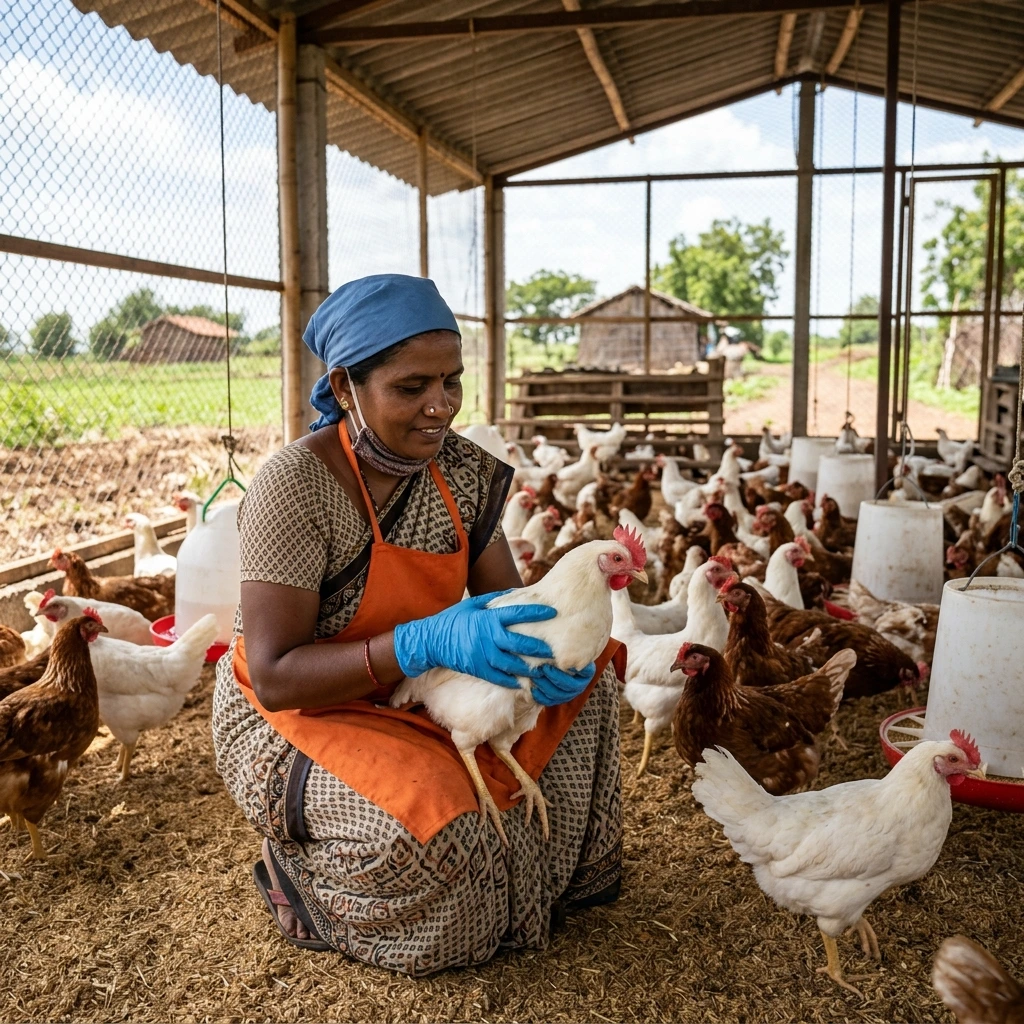
At Apollo Farm, where we raise Sonali desi chickens using a semi free-range system in Bhopal, farm hygiene, personal protective practices during handling, and rapid response to any signs of illness in the flock are part of how we operate. Not because we’re alarmed — but because responsible farming means treating biosecurity as a normal part of the job, not an emergency measure.
The highest-risk scenarios globally have been live poultry markets in regions with poor hygiene infrastructure, backyard poultry kept in close contact with wild waterfowl, and farm operations that lack basic biosecurity protocols. These are conditions where the human-bird boundary breaks down.
The Risk to Farmers: What Practical Biosecurity Means
For anyone raising poultry in India — whether commercial or small-scale — the relevant question isn’t “can I get bird flu?” in the abstract. It’s “am I taking the steps that reduce my exposure risk?”
The answer involves a few straightforward practices. Wearing gloves and avoiding bare-hand contact with sick or dead birds is the first. Not allowing dead birds to accumulate on the farm is the second. Washing hands thoroughly after any direct animal contact is one of the oldest and most reliable defences in infectious disease prevention. If birds are dying in unusually large numbers for no clear reason, reporting to the state animal husbandry department is both a legal obligation in India and a practical response that protects your flock, your neighbours’ flocks, and potentially public health.
Restricting access to your farm — particularly from people who’ve visited other poultry operations without changing footwear and clothing — is also an effective barrier. Avian influenza spreads between farms primarily through contaminated equipment, vehicles, clothing, and footwear, not through the air over long distances.

What About Consuming Poultry Products?
This question comes up constantly, particularly when an outbreak is reported in the news. The evidence here is consistent and clear.
Properly cooked poultry meat and eggs are safe to eat. The influenza virus is inactivated at standard cooking temperatures — reaching an internal temperature of 70°C is sufficient. India’s standard practice of cooking chicken until fully done, not pink, is adequate protection regardless of the heat applied.
The risk from poultry products arises in handling raw meat — particularly if you have open cuts on your hands, or if raw meat comes into contact with other food without subsequent cooking. Normal food hygiene practices during preparation, including washing cutting surfaces and hands after contact with raw poultry, address this adequately.
If you buy poultry from a farm with transparent practices and good health management — where birds are raised in clean conditions and monitored regularly — you’re already a step ahead in terms of confidence in what you’re handling and eating.
India’s Surveillance and Response System
India has experienced avian influenza outbreaks — H5N1 and H5N8 in particular — in domestic poultry over the years, most notably in Maharashtra, Kerala, and other states. The response protocol involves containment zones, culling of affected flocks, and compensation mechanisms for affected farmers.
The National Institute of High Security Animal Diseases (NIHSAD) in Bhopal is the central reference laboratory for avian influenza diagnosis in India. Suspected outbreaks are referred there for confirmation — a system designed to provide rapid, authoritative identification rather than local guesswork.
The Indian Council of Agricultural Research (ICAR) and the Department of Animal Husbandry and Dairying (DAHD) maintain surveillance programmes for avian influenza in both poultry and wild birds. These systems don’t eliminate outbreaks, but they allow faster containment than would be possible without them.
The Pandemic Question
The scenario that public health agencies monitor closely — and that generates the most attention in scientific literature — is the possibility that an avian influenza strain could mutate sufficiently to spread efficiently between humans. This is how influenza pandemics have historically originated.
The 1918 influenza pandemic, which killed an estimated 50 million people globally, involved an influenza A virus with avian origins. The 2009 H1N1 pandemic involved a reassortment of human, avian, and swine influenza genes.
This is why surveillance of avian influenza is taken seriously by global health organisations far beyond the direct human case counts. The monitoring isn’t only about the current risk — it’s about watching for the genetic changes that could alter that risk.
But to be clear: this is not an imminent scenario with current strains. Current H5N1 and related strains do not spread between humans. The concern is real and the monitoring is warranted, but it should not translate into general public alarm about ordinary contact with well-managed domestic poultry.

FAQ: Avian Influenza and Human Health
Can I get bird flu from eating chicken?
No, not from properly cooked chicken. The avian influenza virus is destroyed at standard cooking temperatures. Properly cooked poultry meat and eggs carry no documented risk of avian influenza transmission.
How does bird flu spread from birds to humans?
Almost always through direct, close contact with infected birds or contaminated environments — handling sick or dead birds, exposure to their blood, faeces, or respiratory secretions, or working in live poultry markets with poor hygiene conditions.
Does bird flu spread from person to person?
Current avian influenza strains do not spread efficiently between humans. The vast majority of human cases result from direct animal-to-human transmission. There is no documented sustained human-to-human transmission for any current strain.
What are the symptoms of bird flu in humans?
Symptoms resemble severe influenza: high fever, cough, sore throat, muscle aches, and in serious cases, pneumonia. Anyone who has had direct contact with sick or dead birds and develops these symptoms should seek medical attention and inform the doctor of the potential exposure.
Is it safe to keep backyard chickens?
Yes, with standard biosecurity practices — keeping poultry away from wild waterfowl, monitoring for signs of illness, and practising hand hygiene after handling birds. Small-scale and backyard poultry farming is not inherently high-risk when managed sensibly.
What should I do if birds on my farm start dying suddenly?
Contact your state animal husbandry department immediately. Do not handle dead birds without protective gloves. Restrict movement on and off the farm. Rapid reporting is both a legal requirement and the most effective response.